I’ve always described myself as a believer in the 3Ps: people, process and product. AI has changed the process part dramatically and the product part a lot. It hasn’t touched the people part, and I don’t think it will.
When I first outlined this playbook, chapter 002 was about empathy. At the time it felt a bit soft for a product book. Now it might be the most important chapter in it. Here’s what I think stays human:
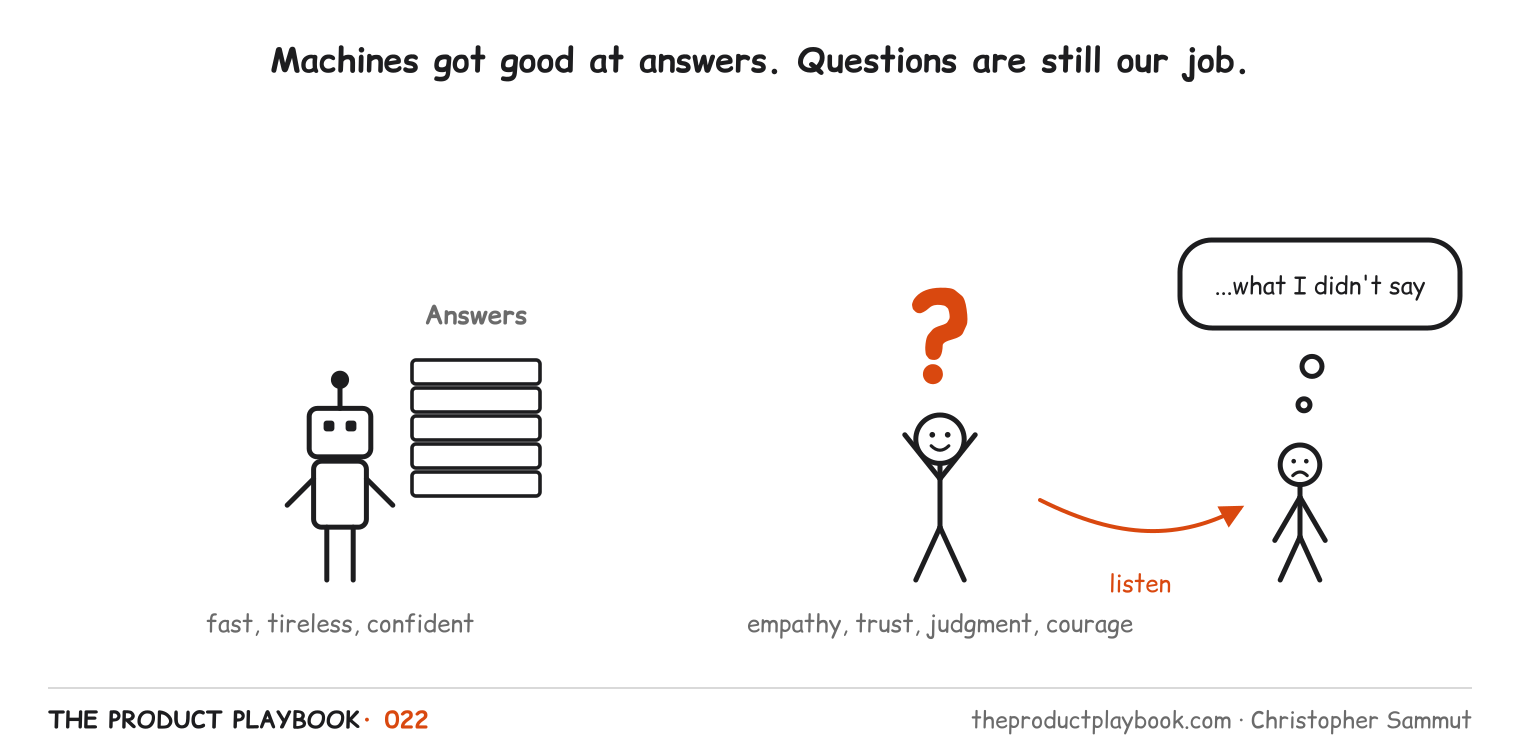
Empathy. AI can summarise a hundred user interviews in seconds. It can’t sit across from a frustrated user and notice the thing they didn’t say. That moment is still where the best product insights come from.
Trust. I co-founded the Responsible Affiliate Network because in our industry, trust is the product. Users trust you to be honest, partners trust you to play fair, and regulators trust you to behave. You can’t automate being trustworthy. You can only earn it, slowly, and lose it quickly.
Judgment under uncertainty. Every big decision I’ve signed off on, whether an acquisition, a market entry or a new strategy, came down to a call made with incomplete information. AI made my analysis faster and better. It didn’t make the call, and it didn’t carry the responsibility for it.
Courage. Saying no. Killing your own project. Telling the board what they don’t want to hear. Telling a team the plan has changed. No model does that for you.
Curiosity. My LinkedIn says “AI Curious” and I mean it. The people I want on my team in the next ten years are the ones who keep asking questions, of the users, of the data, and of the AI itself.
Which brings us back to where this whole playbook started: it’s about asking the right questions. The machines are getting very good at answers. Questions are still our job.
Borrowed thinking
Spotify’s co-CEOs put it neatly when describing their 2026 plans: at Spotify, AI isn’t about automation or taking your hands off the wheel, it’s about agency.
That’s the line between a tool and a replacement. The human keeps the wheel.
The question to ask yourself: what part of my work would I be proud to say only a human could have done? Do more of that.