This whole playbook is built on one belief: the quality of your product depends on the quality of your questions. Answers are cheap. Good questions are rare.
I learned this the hard way in prioritisation meetings. We’d spend an hour debating which feature to build when nobody had asked whether the problem behind it was real. The loudest stakeholder usually won. The users usually lost.
A few questions I keep coming back to, whether I’m reviewing a product spec or an acquisition target:
- What would have to be true for this to work?
- How will we know if we’re wrong, and how fast?
- Who is this for, specifically, and what are they doing today instead?
- Why now? What changed that makes this worth doing this quarter?
- What are we not doing because we’re doing this?
The other half of asking the right questions is asking them to the right people. Engineers will spot the hidden complexity. Support will tell you what users actually complain about. Finance will tell you what it really costs. A product manager who only asks other product managers is in an echo chamber.
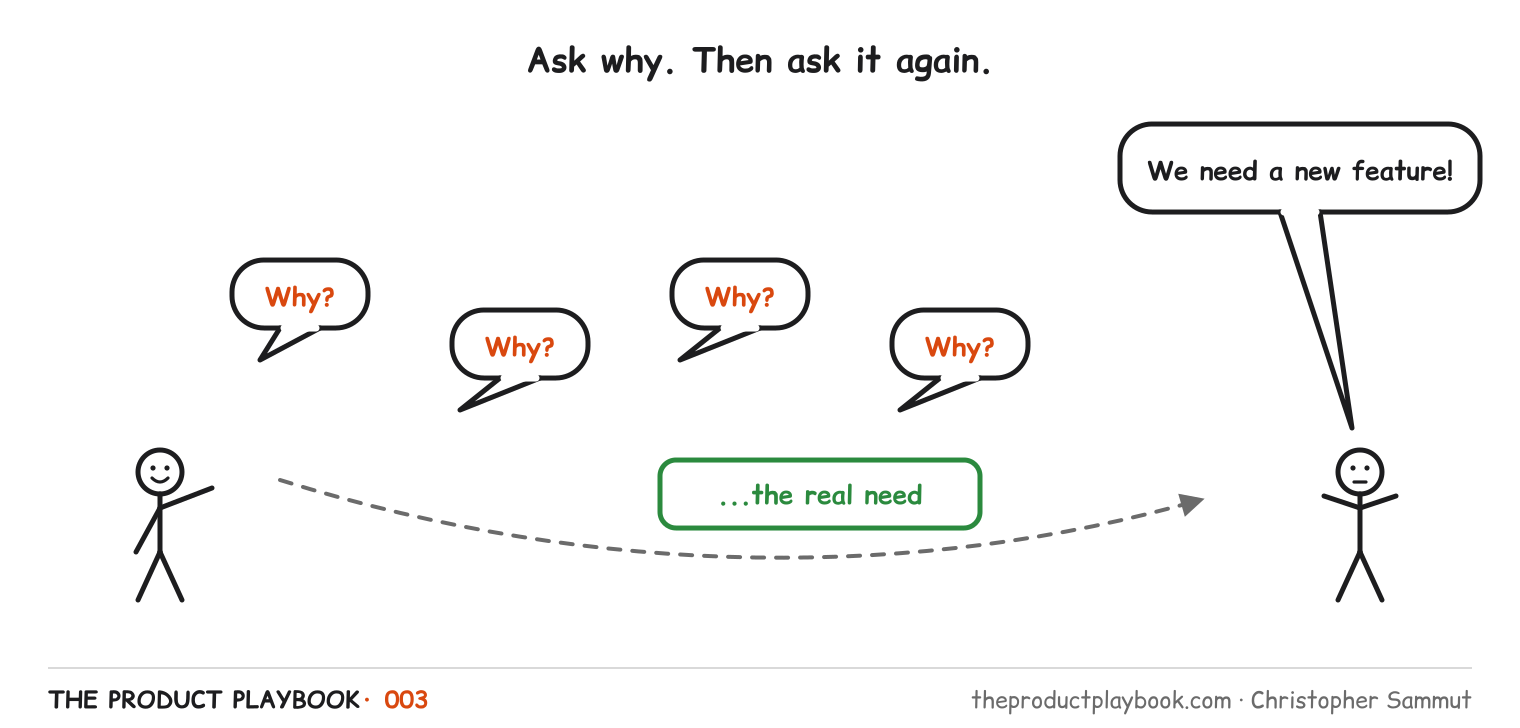
And sometimes the most useful question is the simplest one: “Why?” Asked five times, patiently, it gets you from the feature request to the real need underneath.
Borrowed thinking
The sharpest version of this I know comes from Elon Musk. Step one of what he calls “the algorithm” is to question every requirement, and every requirement should come with the name of the person who made it, not a department. A person can be asked why; a department can’t. He adds that requirements from smart people are the most dangerous, because nobody questions them. (source)
I’ve started asking “whose requirement is this?” in every planning session. It’s amazing how many turn out to belong to nobody.
The question to ask yourself: what question am I avoiding because I’m afraid of the answer? That’s usually the one to ask first.