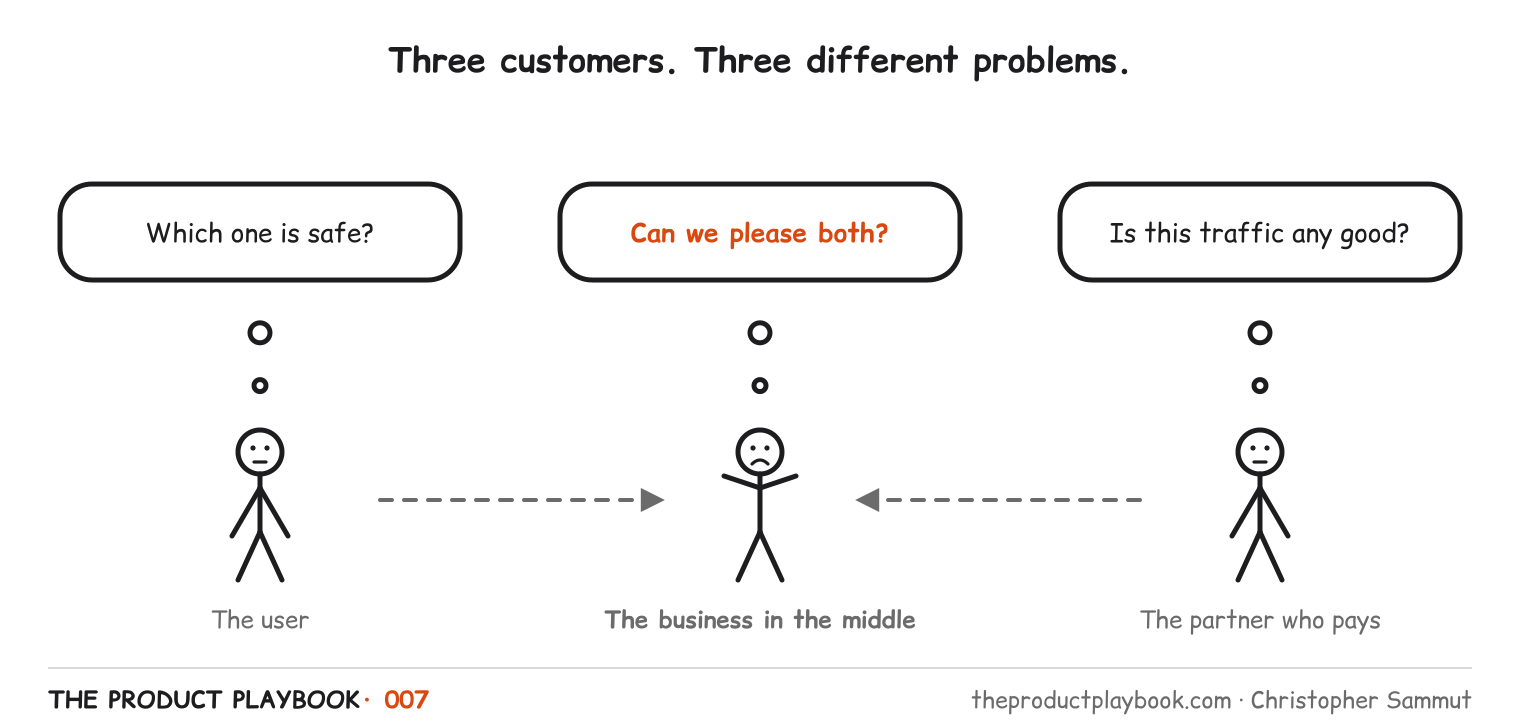
This sounds like the simplest question in the playbook. It’s the one I see teams get wrong most often.
In the affiliate and media world I’ve spent much of my career in, there are always at least three customers: the user trying to make a decision, the partner or operator paying for the referral, and the business in the middle trying to make both happy. Each has a different problem. Build for the wrong one and you’ll ship something that pleases nobody.
The same is true everywhere. A feature request from sales is usually a customer’s problem seen through a salesperson’s eyes. A request from leadership might be a board member’s problem. A request from support is often a symptom of a problem somewhere else in the product.
Before you write a single user story, answer three things:
- Who feels the pain? Name them. A real segment, ideally a real person you’ve spoken to.
- Who pays for the solution? It’s not always the same person, and that changes everything about how you build and sell it.
- Who decides it’s solved? If you don’t know what “done” looks like to them, you’ll never get there.
When those three answers point to different people, you don’t have one problem, you have a negotiation. Better to know that before the build than after the launch.
Borrowed thinking
When Spotify’s new co-CEOs, Alex Norström and Gustav Söderström, set out their priorities for 2026, the first one was about the listener, not the business: build a product that leaves people feeling better at the end of every session. (source)
In a two- or three-sided business, the user’s outcome is the one most easily traded away. It’s also the one everything else depends on.
The question to ask yourself: whose problem am I really solving with my current roadmap, and would they recognise it as theirs?