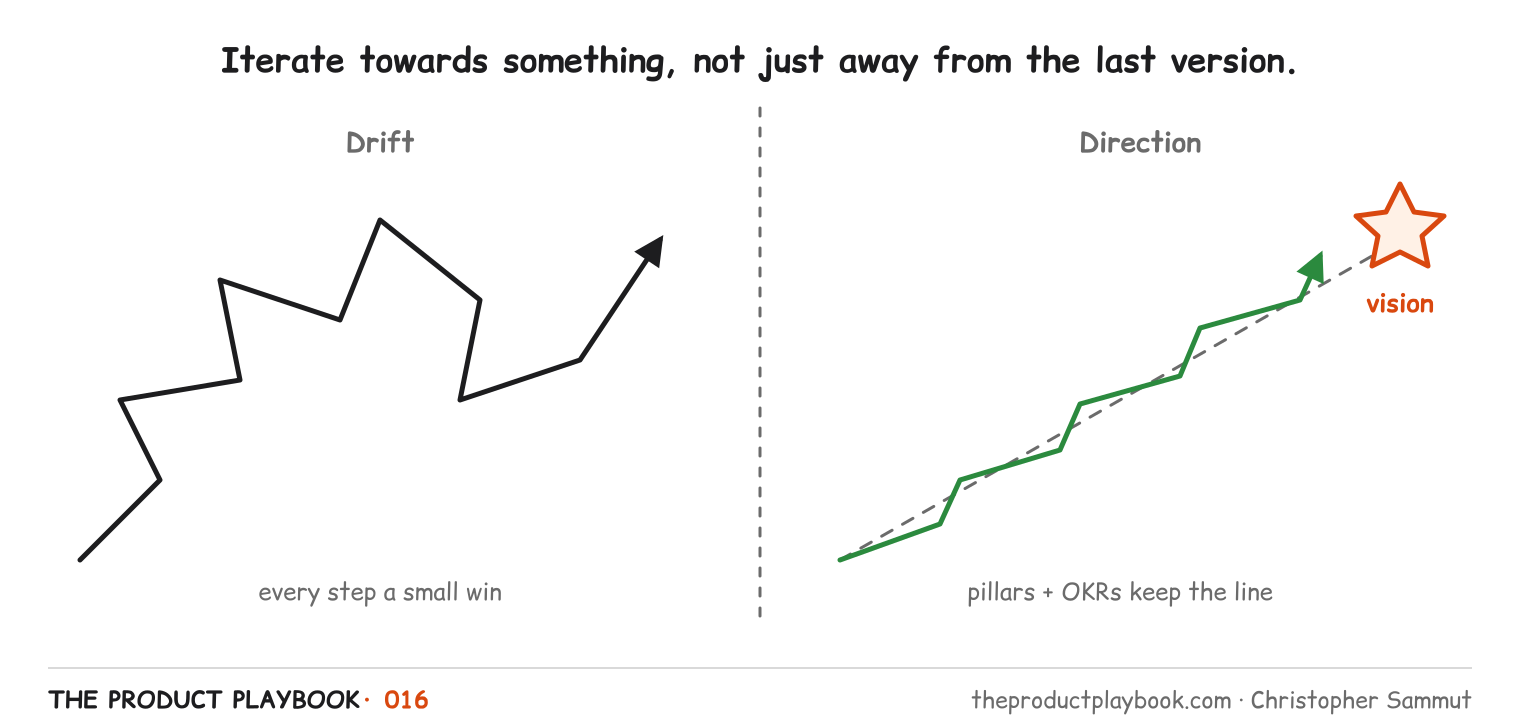
Iteration is how good products get built: ship, learn, improve, repeat. But iterate long enough without a direction and you end up with a product that’s a pile of good small decisions adding up to one confusing whole.
I’ve seen it in growth teams, my own included. Every experiment wins a little. The conversion rate goes up. And a year later the product feels like five different products stitched together, because each test optimised one screen and nobody looked at the journey.
What keeps iteration coherent is a direction everyone can see. I like annual strategic pillars and quarterly objectives for exactly this. The pillars say where you’re going. The quarterly objectives say what you’ll learn or change this quarter to get closer. Individual experiments could go anywhere, as long as they pointed the same way.
A few habits that help:
- Write down the vision in one paragraph, and check every big change against it.
- Zoom out every quarter. Walk the whole journey, not just the screens you changed.
- Keep a design system. It’s the cheapest way to stop a product fragmenting.
- Be willing to undo. Sometimes the right iteration is removing three earlier ones.
Iteration without vision is drift. Vision without iteration is a slide deck. You need both, at the same time, all the time.
Two principles I’ve carried from role to role: champion right over easy, and simplicity over complexity. That’s how you protect a product’s coherence over the long term. And be great with data, but guard every pixel. A product drifts one small, sensible-looking change at a time.
The question to ask yourself: if a new user saw my product for the first time today, would it feel like one product or a collection of experiments?