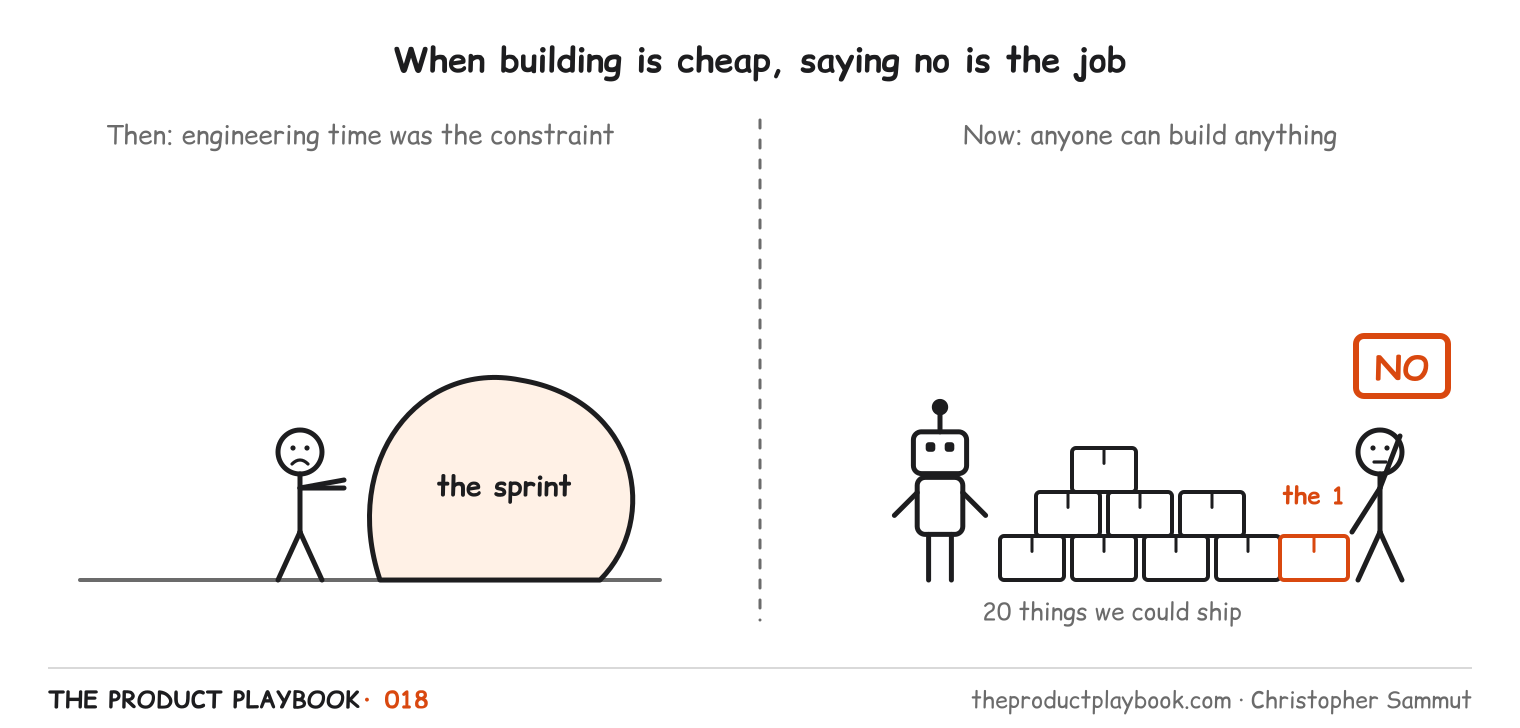
When I ran an acquisition team for an online casino across 11 markets, the most expensive thing in the room was engineering time. Every prioritisation meeting was really a negotiation over it. We wrote user stories, drew wireframes, argued over the backlog, and the winner got a slot in the next sprint.
That constraint is disappearing. Today a PM, a designer, or honestly a curious marketer can describe a feature and have a working prototype before lunch. My own background is software engineering, and even I find it slightly unsettling how fast that went from party trick to default.
So what’s left for us?
Deciding what is worth building. When building is cheap, you’ll build more of the wrong things faster. The scarce skill isn’t shipping, it’s saying no to the twenty things you could ship this week.
Framing the problem. AI is brilliant at answering the question you give it. It’s not great at telling you that you’ve asked the wrong one. That’s still your job (see Part 3).
Owning the outcome, not the output. I’ve spent years setting OKRs for teams. The good ones were always about outcomes. With AI, output stops being a meaningful measure, because anyone can generate output. Outcome is the only thing left to measure.
Taste. Knowing when something is good, not just done. You can’t prompt your way to taste. You build it by shipping, watching real users, and being wrong a lot.
My honest take: the PM role doesn’t die, it gets promoted. Less project manager, more product owner in the true sense, someone who owns the result. If you’ve been hiding behind process and Jira tickets, it’s time to come out.
Borrowed thinking
Nikita Bier, who built viral consumer apps before becoming X’s head of product, said his team launched around 30 products in roughly 13 months before he stepped back in 2026. (source) Outside observers questioned some of the growth claims, which is its own lesson: shipping fast is now the easy part. Proving it moved the outcome is the job.
The question to ask yourself: if building cost nothing tomorrow, what would I still be needed for? Write the answer down. That’s your job description now.