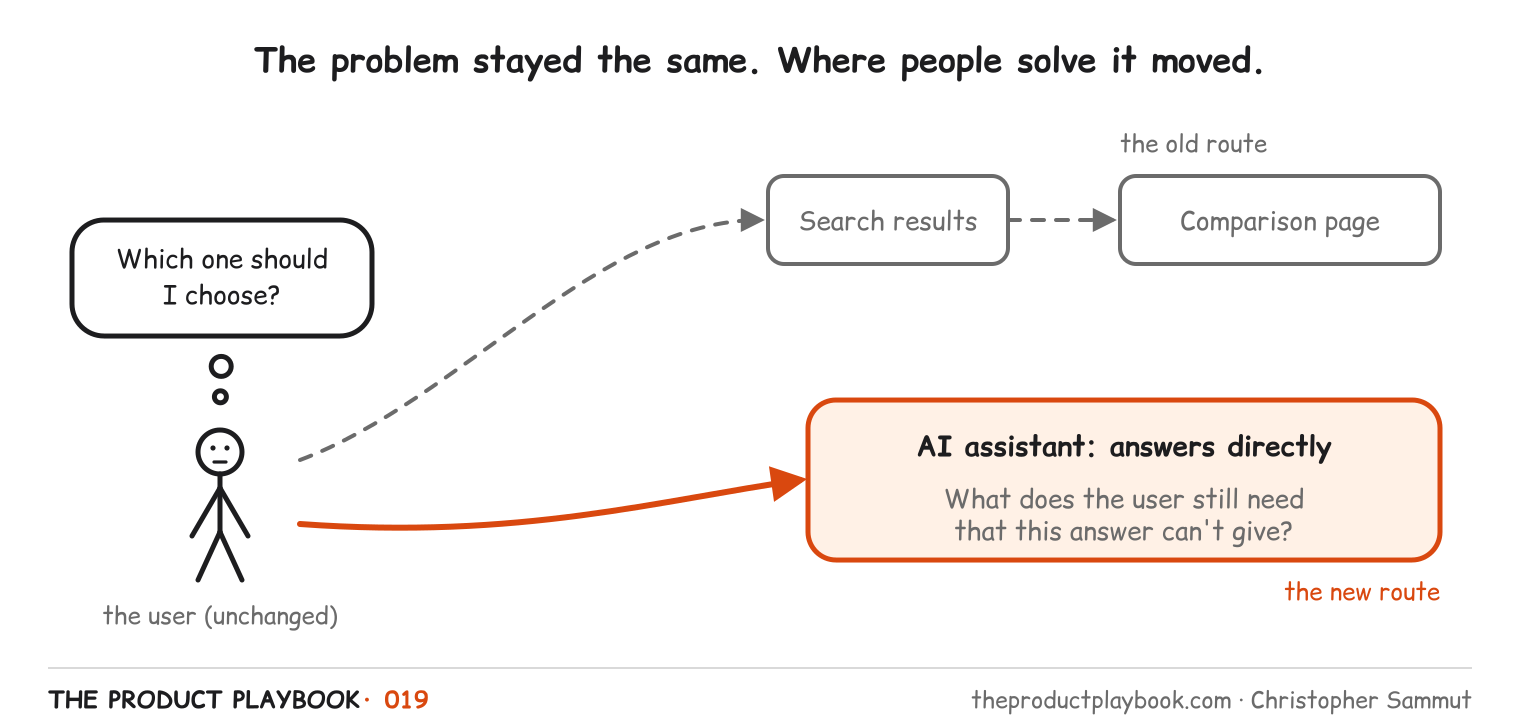
Most of my career has been in businesses that help people make a decision. Which casino, which broker, which crypto exchange, which tool. In the affiliate and media businesses I’ve worked in, the model was simple. Someone types a question into Google, lands on a page that helps them decide, and clicks through to a partner. Our job was to be the most useful page for that question.
Now a lot of those people never reach Google. They ask an AI assistant, and it answers them directly.
This is where it’s tempting to panic and start solving the wrong problem: “How do we get our traffic back?” That’s our problem, not the user’s.
Go back to Part 2 and ask the same old question: whose problem is it? The user’s problem hasn’t changed one bit. They still want to make a good decision, with confidence, without getting burned. What changed is where they go to solve it, and what they expect when they get there.
So the useful questions become:
- What does the user still need that an AI answer can’t give them? Proof, real experience, up-to-date data, someone accountable.
- What part of my product was really just friction that AI now removes for free? Be honest; that part is gone.
- Where does my product show up now? In a chat window, inside someone else’s product, through an API? The interface may not be yours anymore.
I’ve watched teams spend months optimising for a channel that was quietly shrinking under them. The ones that came out ahead went back to the user’s problem first and rebuilt the solution around it, not around the old channel.
The question to ask yourself: if my product disappeared tomorrow, would the user’s problem go unsolved, or would an AI quietly solve it instead? If it’s the second, you have work to do.