After nearly fifteen years in product and operations, from fixing sign-up flows to signing acquisitions, I’ve noticed that the way I solve problems hasn’t really changed. Only the size of the problems has.
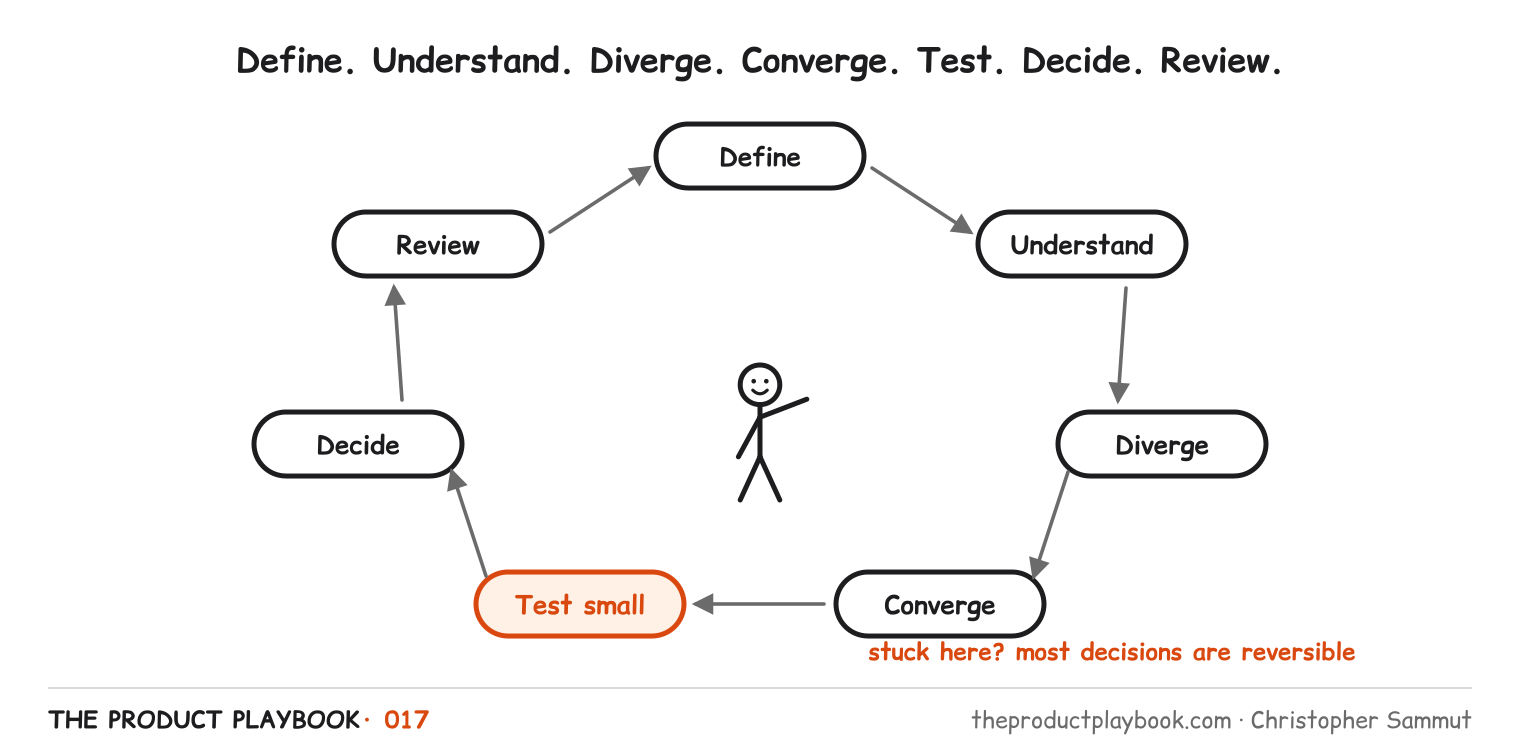
This is the loop I use, whether it’s a bug, a market entry or a new product line:
- Define. Write the problem in one sentence, with a number in it, and no solution (see chapter 008).
- Understand. Talk to the people who have the problem and the people who’ll have to fix it. Look at the data, then look at the humans behind it.
- Diverge. Generate more options than feel necessary. The first idea is rarely the best, it’s just the first.
- Converge. Pick using clear criteria agreed in advance: impact, cost, risk, reversibility.
- Test small. Find the cheapest way to learn whether you’re right before committing fully.
- Decide and commit. Then tell people what you decided and why.
- Review. Did it work? What would you do differently? Write it down.
The step people skip most is the last one. The step people get stuck in is the fifth. Analysis paralysis is real, and the cure is remembering that most decisions are reversible. Treat those ones quickly. Save your slow, careful thinking for the few that aren’t.
And don’t solve alone. The best solutions I’ve been part of came from mixed rooms: engineers, designers, finance, support, and the occasional person who asked the obvious question everyone else had missed.
One more lesson, from the project in chapter 012: challenge the deadline. A date set by someone else’s timetable is a constraint, not a plan. Ask what the smallest useful version is, and whether that can ship first.
The question to ask yourself: is this decision reversible? If yes, why am I still deliberating?