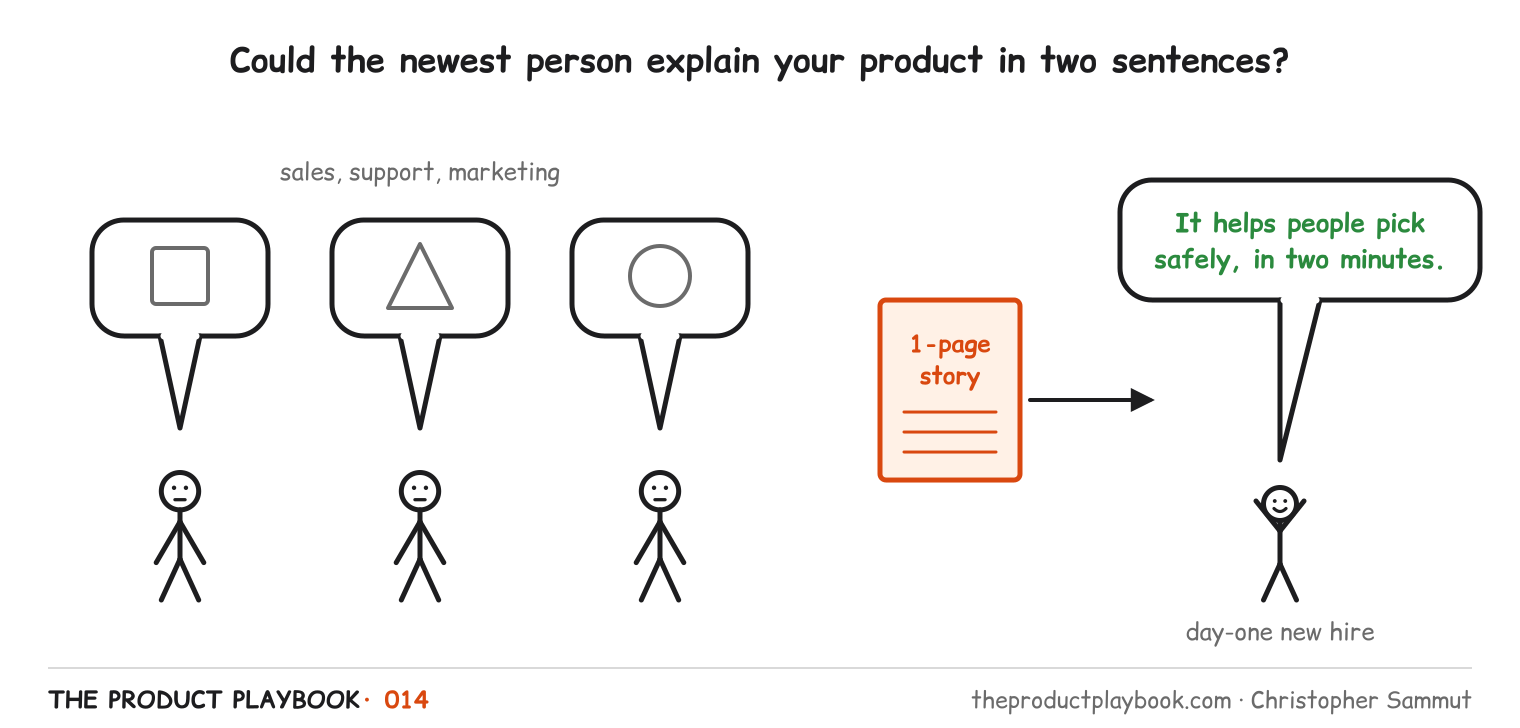
You probably understand your product. The question is whether everyone else does: sales, support, marketing, finance, leadership and, most importantly, your users.
When I led a company rebrand, I learned how much work it takes to get a whole company telling the same story. Rewriting the mission statement took weeks. Making sure people could explain it in their own words took far longer. A product nobody can explain is a product nobody can sell, support or improve.
Signs your product isn’t understood:
- Sales describe it differently in every pitch.
- Support spend their days explaining what it’s for, not how to use it.
- New hires take months to “get it”.
- Users ask for features you already have.
What has worked for me:
- Write a one-page story: who it’s for, what problem it solves, why it’s better, what it isn’t. Update it every quarter.
- Test it on someone outside the team. If they can’t repeat it back, simplify it.
- Brief support and sales before launch, not after the first angry ticket.
- Let users explain it. The words customers use are usually better than the ones you wrote.
Understanding isn’t a launch task, it’s a habit. Products change, people join and leave, and the story drifts unless someone owns it.
Borrowed thinking
Jensen Huang has made the point with a simple question: if there’s a strategic direction, why tell only one person? (source) He preferred to explain direction to everyone at once, so nobody had to rely on a version passed down through layers.
Every layer a message passes through is a chance for the product story to drift.
The question to ask yourself: could the newest person in my company explain what my product does, and why, in two sentences?