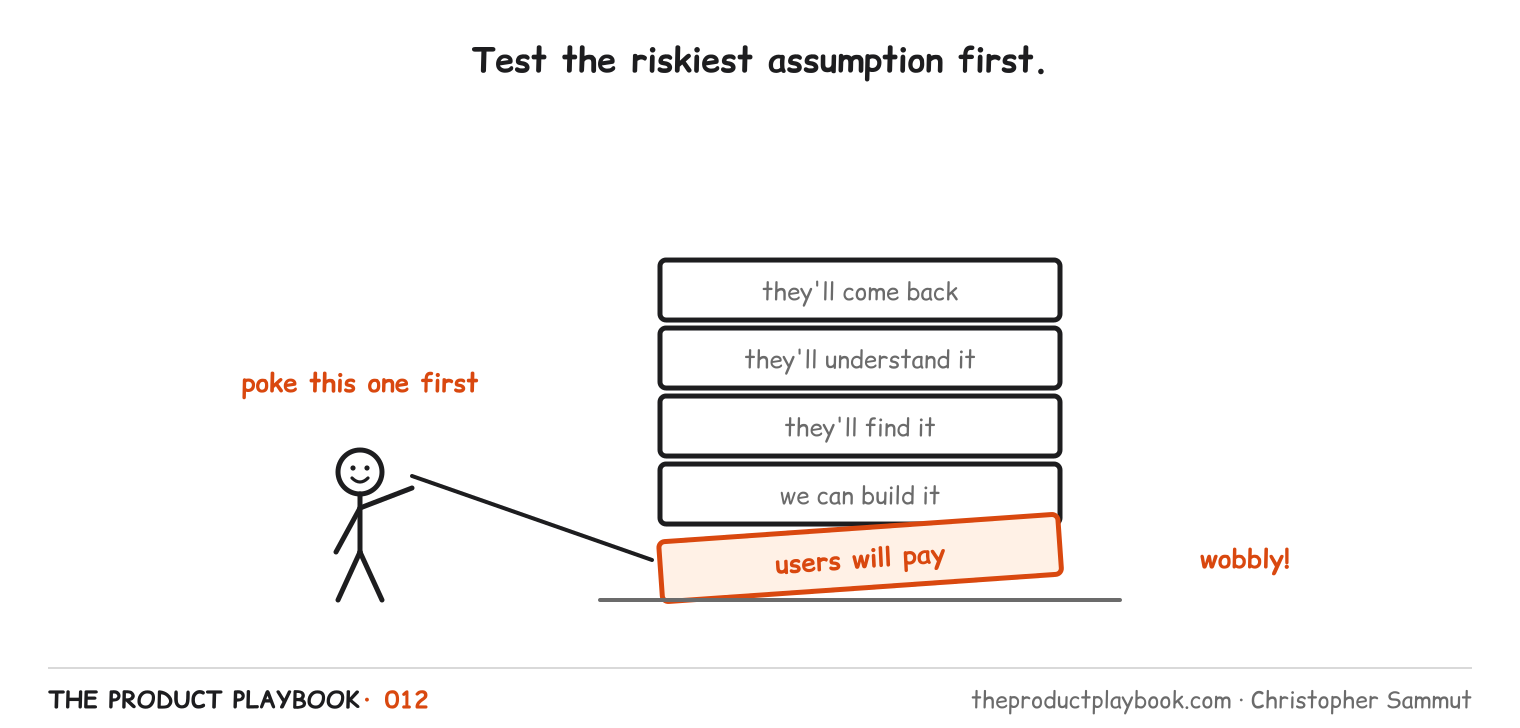
You’ve found a real problem, you know it’s worth solving, and you have a list of twenty things you could build. Which one goes first?
My rule: build first whatever proves or kills your riskiest assumption. Not the easiest thing, not the most impressive thing, and definitely not the thing the most senior person asked for.
Every idea rests on a stack of assumptions. Users have this problem. They’ll find our solution. They’ll understand it. They’ll pay for it, or come back for it. We can build it at a sensible cost. Usually one of those is shaky, and that’s the one to test before anything else.
In practice that means:
- Write the assumptions down and rank them by how risky and how important they are.
- Build the smallest thing that tests the top one. Sometimes that’s a prototype. Sometimes it’s a landing page, a manual process or a conversation.
- Decide in advance what result means stop. Otherwise every result will look like a reason to continue.
- Then build the foundations properly. Speed early, quality once you know it’s worth it.
I’ve run a lot of prioritisation meetings, and the best ones started with “what do we need to learn?” rather than “what do we want to build?” That one change made the debates shorter and the outcomes better.
AI makes this easier than ever. A prototype that once took a sprint can now take an afternoon. There’s no longer any excuse to build the full thing before testing the risky part.
The project I’d do differently
Early in one role, I was handed a project on my first day with a simple brief: “do this”. The product was a single-page JavaScript app, and the logged-out pages had to be rebuilt so search engines could still read them, because Google was retiring the old way of crawling apps like ours. The deadline was set by Google’s timetable, not ours.
We delivered. But looking back, I’d do two things differently. I didn’t push hard enough to make sure the whole team was happy with how we were building it. And I didn’t challenge the deadline, even though a smaller first version would have got us to market faster, so we could learn from it and improve.
That project is where my release habit comes from:
- Understand the problem the release is meant to solve.
- Break it into small user stories and refine them with the team.
- Ship the bare minimum to a private beta, and decide up front how you’ll collect feedback.
- Soft-launch to a subset of users and check the metrics the release was meant to move.
- Only then announce it widely.
- Keep monitoring and iterating. It’s an endless loop, not a finish line.
The question to ask yourself: what is the one assumption that, if wrong, makes everything else on my roadmap pointless? Am I testing it first?