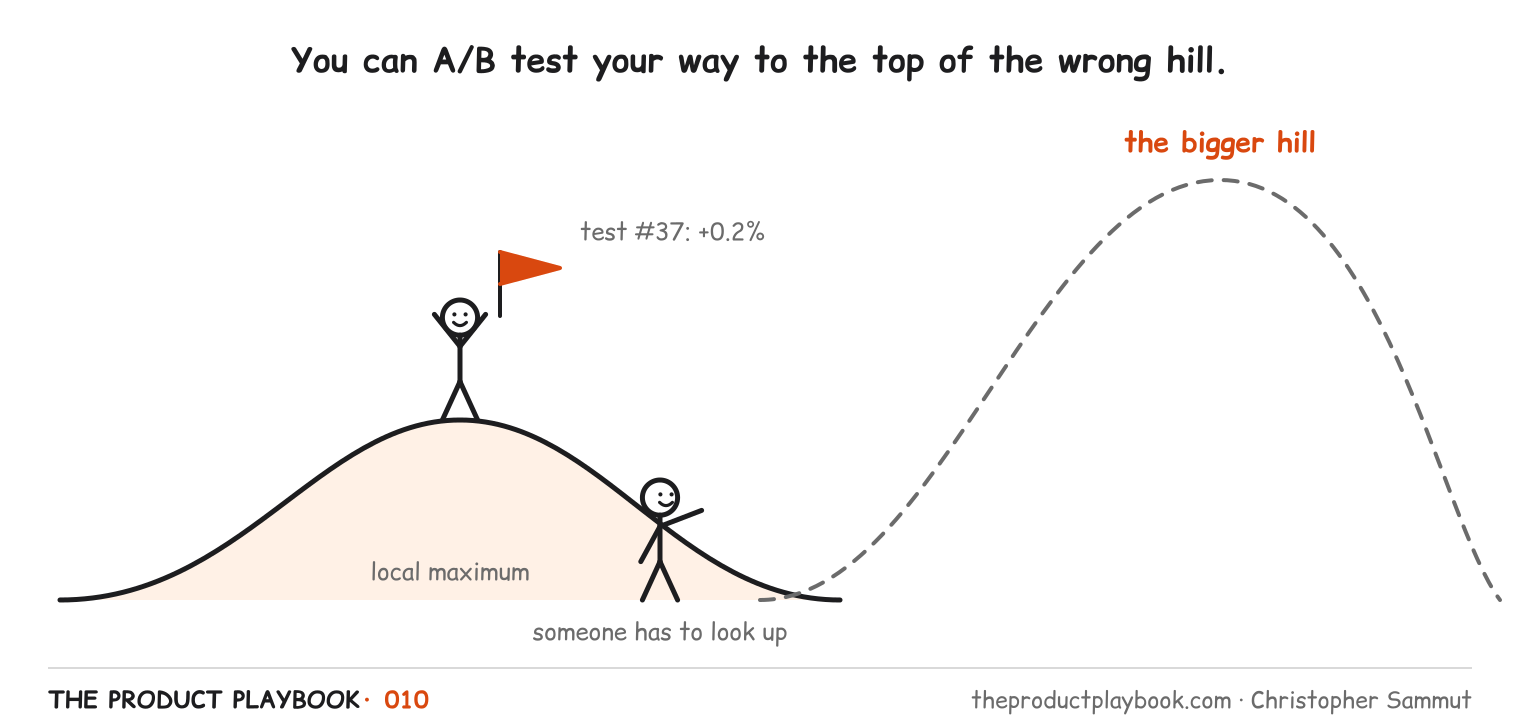
Every product team lives with this tension. Optimise what you have, or build something new? Make the engine run better, or design a new engine?
Much of my early career was optimisation. At an affiliate media group and later an online casino operator, we ran continuous experiments across many sites and markets: page layouts, copy, flows, offers. Small wins, compounded, added up to real money. It’s measurable, it’s safe, and it keeps a business healthy.
But optimisation has a ceiling. You can A/B test your way to the best possible version of the wrong product. Somebody has to ask whether the whole thing should look different.
How I’ve tried to balance it:
- Optimise by default. Most of the team’s time should go into making the core product better, because that’s where most of the value is today.
- Protect time for bets. A small, ring-fenced slice for ideas that might fail. If it isn’t protected, urgent work will eat it every time.
- Judge them differently. Optimisation is judged on lift. Innovation is judged on learning. Punish a failed bet and nobody will make another one.
- Watch for the moment the curve flattens. When every test gives smaller wins, that’s the signal to innovate, not to test harder.
AI has made this question sharper. Some of what used to be innovation is now just optimisation with better tools. And some of what we optimised for years is about to be replaced.
Expect to be wrong, a lot
If you run experiments, expect most of them, perhaps nine in ten, to fail. That isn’t waste. An experiment only fails if you don’t learn from it.
Be careful what you measure, too. Academic researchers are often judged on how many papers they publish, which rewards output rather than outcome. Product teams fall into the same trap when they count tests shipped instead of what those tests changed.
For a long backlog of experiments, I’ve used a simple ICE score: Impact, Confidence and Ease, each out of 10. It isn’t science, but it forces the conversation about why one idea should go before another.
The question to ask yourself: am I polishing something that’s about to become irrelevant?