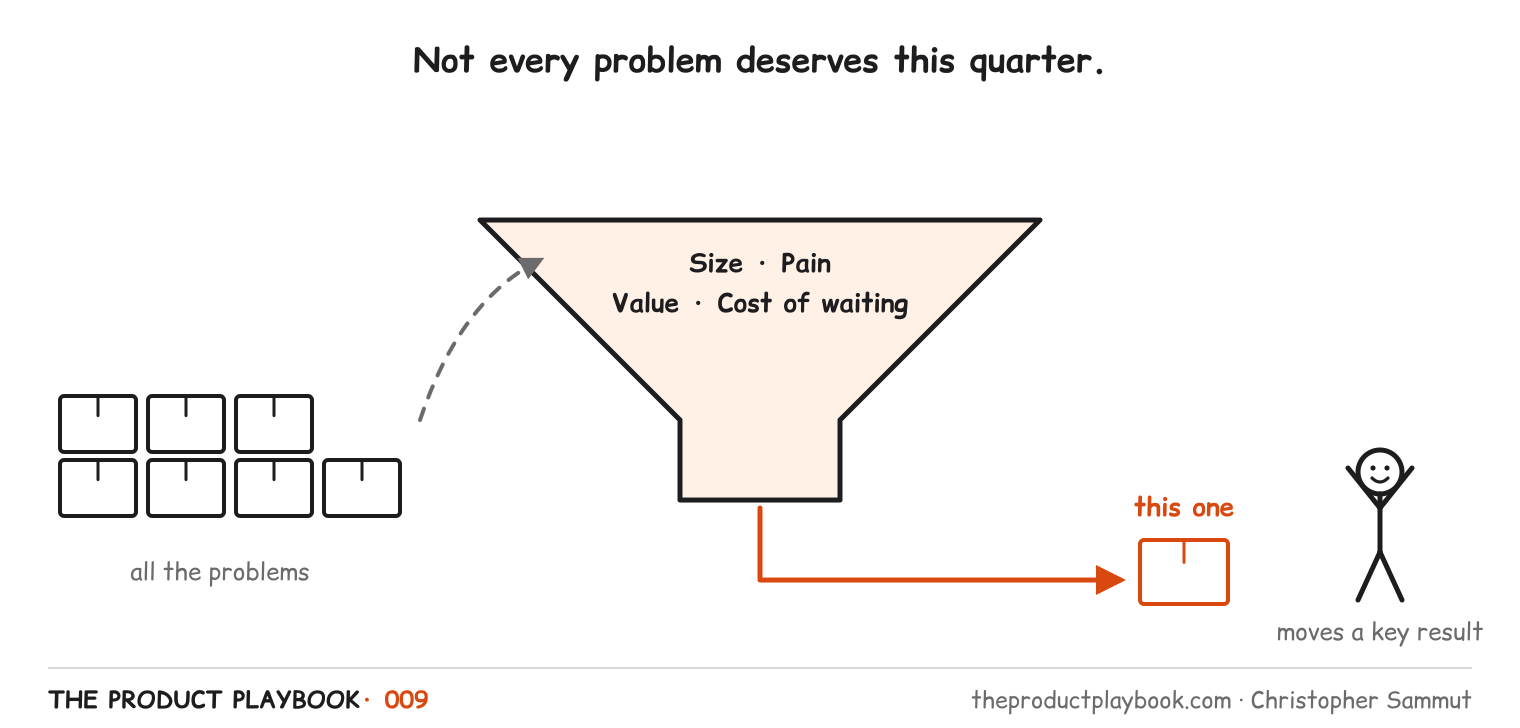
Every team has more problems than it can solve. So knowing that something is a problem isn’t enough. You need to know why it’s worth solving now, instead of everything else.
As a Head of Product and later CPO, part of my job was deciding which markets to enter and which to leave alone. Later in my career the same question came back in a bigger form with acquisitions: is this worth our money, our people and our attention? The thinking is the same whether it’s a button or a business.
The four checks I use:
- Size: how many people have this problem, and how often?
- Pain: how much does it hurt? A daily annoyance beats a yearly inconvenience.
- Value: what changes for the user, and for the business, if it’s solved? Tie it to an objective you already care about.
- Cost of waiting: what happens if we solve it next quarter instead? If the honest answer is “nothing much”, it can wait.
This is where objectives and key results (OKRs) earn their keep. In every team I’ve seen use them well, the biggest benefit wasn’t the targets themselves. It was having a shared filter. A problem that didn’t move a key result needed a very good reason to jump the queue.
And always count the opportunity cost. Saying yes to one problem is saying no to another, whether you admit it or not.
A business case that outlived me
At a sportsbook operator I wrote the business case to add a live casino inside the mobile app, and worked with a third-party provider on how to deliver it. It went live after I’d moved on.
That taught me what a business case is really for. It isn’t a forecast to get a yes in a meeting. It has to explain who wants this, why now, and what it costs, clearly enough that someone else can carry it over the line without you in the room.
Borrowed thinking
Lyn Alden, the macro investor, was once asked to name her biggest edge in one thing. Her answer: a long-term view, because so much of the market is judged monthly or quarterly. (source)
Product teams have the same problem. Quarterly goals are useful, but some problems are only worth solving if you’re willing to look further out than one quarter.
The question to ask yourself: if I could only solve one problem this quarter, would it be this one? If not, why am I working on it?