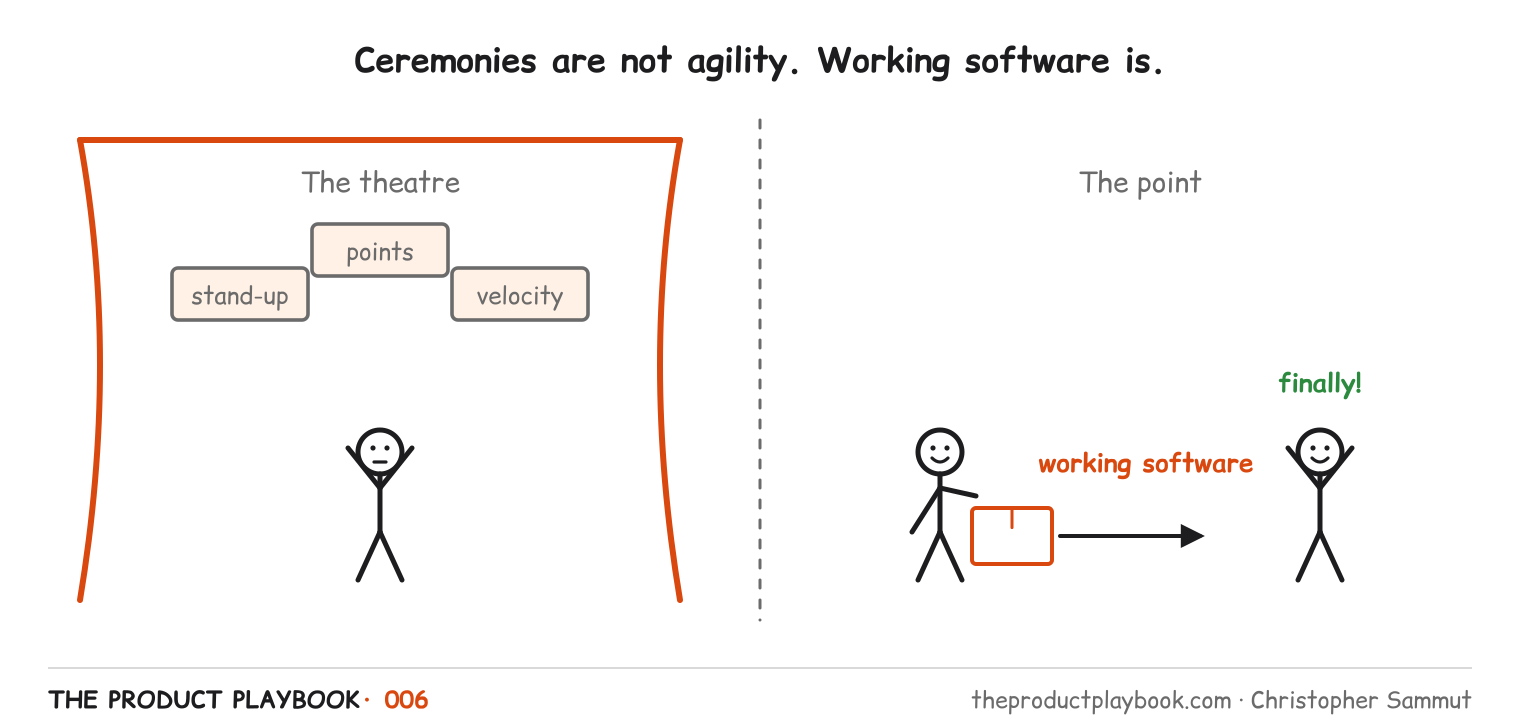
I’m a certified Scrum Product Owner and ScrumMaster, and I’ve helped roll out agile tooling across a company of about 350 people. So let me say something slightly controversial: most teams that call themselves agile are doing ceremonies, not agility.
Go back and read the Agile Manifesto. It’s four lines. Individuals and interactions over processes and tools. Working software over comprehensive documentation. Customer collaboration over contract negotiation. Responding to change over following a plan.
Notice what it doesn’t say: nothing about story points, velocity charts, two-week sprints or how long a stand-up should be. Those are useful practices. They’re not the point.
So does it still hold? I think it holds better than ever, especially now that AI makes building faster and plans go stale sooner. What I’d keep and what I’d drop:
- Keep: short feedback loops, working software as the measure of progress, and teams that can change direction without a committee.
- Keep: retrospectives. The one ceremony that actually makes a team better, if people are honest in them.
- Drop: process for its own sake. If a meeting doesn’t change a decision, cancel it.
- Drop: velocity as a goal. Output is easy to inflate. Outcomes aren’t.
Agile was always a mindset, not a method. The manifesto still holds. Our habits are what drifted.
Borrowed thinking
Deel’s CEO Alex Bouaziz names speed as one of the company’s core values, and is specific about what he means: when a customer needs something, you handle it today rather than postponing it. (source)
That’s the Agile Manifesto in one sentence, without a single ceremony: respond to change, close to the customer, today.
The question to ask yourself: which of my team’s rituals would we keep if nobody was watching? The rest are probably theatre.