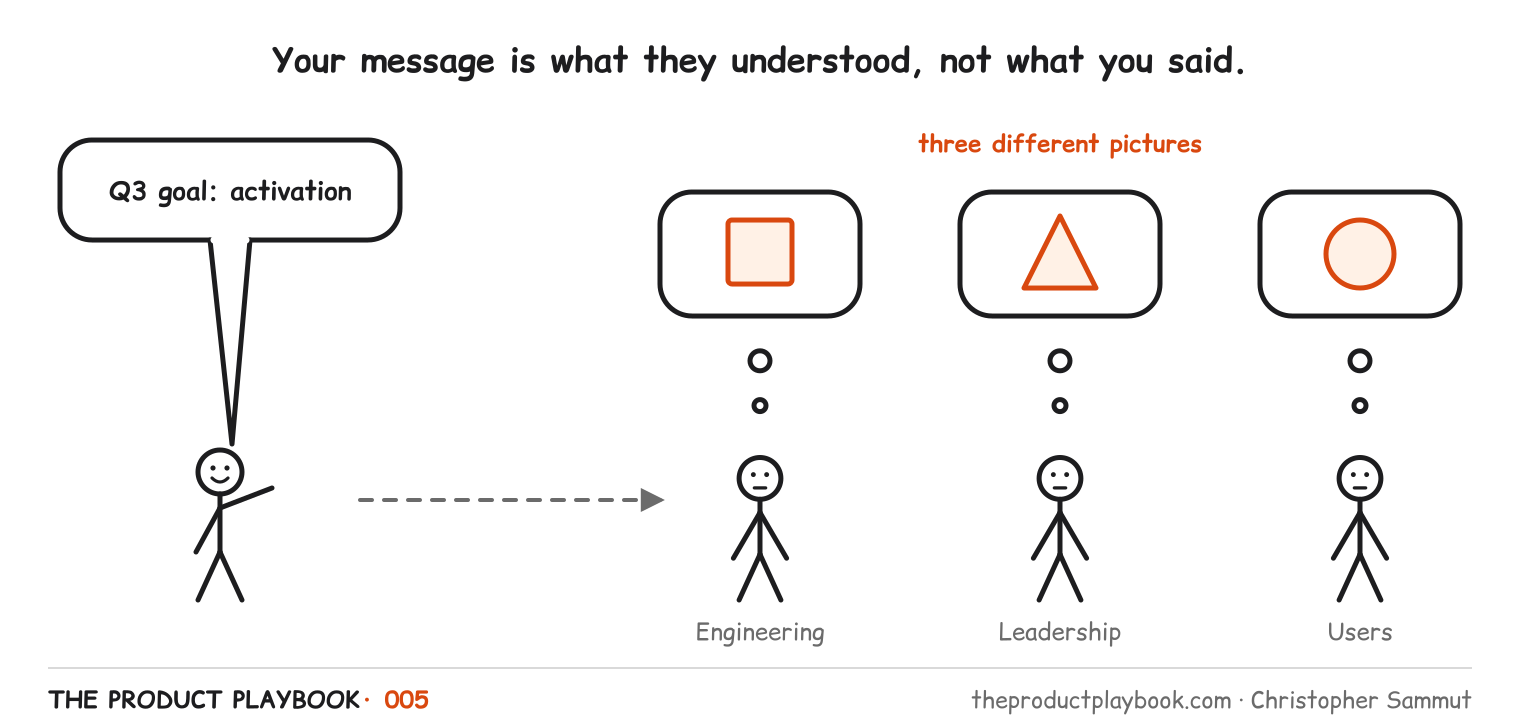
“Great communicator” appears in every product job description, and it’s the skill people most overrate in themselves. I include myself in that.
As a product manager you talk to engineers, designers, marketers, compliance, finance and leadership, often in the same afternoon. Later, as an executive, I reported to boards who had ten minutes and a hundred other priorities. Same principle every time: your message is what they understood, not what you said.
Things that have worked for me:
- Lead with the answer. Then the reasoning. Busy people decide in the first sentence whether to keep reading.
- Change the language, not the message. Engineers want the problem and the constraints. Leadership wants the outcome and the risk. Users want to know what’s in it for them.
- Write it down. In remote, multi-cultural teams, a clear written brief beats three meetings. If you can’t write it in one page, you don’t understand it yet.
- Show, don’t tell. In one growth team I ran, I hosted demo sessions and retrospectives. A two-minute demo ended more debates than any slide deck.
- Say the bad news early. Slipped dates and failed experiments only get more expensive the longer you sit on them.
And listen more than you talk. Most miscommunication isn’t a delivery problem, it’s a listening problem.
Borrowed thinking
Jensen Huang, Nvidia’s co-founder and former CEO, takes this to an extreme. He has run dozens of direct reports without one-on-ones, saying almost everything to everyone at once, and gives feedback in the room rather than behind closed doors. His reasoning: your contribution shouldn’t depend on privileged access to information.
I wouldn’t copy it wholesale. But the principle is worth stealing: if only some people hear the message, it isn’t communication, it’s rumour management.
The question to ask yourself: if I asked three people who work with me to explain our product’s goal for this quarter, would they give the same answer?