This is the chapter I didn’t plan to write in 2015, because back then I thought org design was someone else’s job.
Then I spent years doing it, designing departments and leadership structures as a business grew several times over. Then AI changed the shape of the work, and the question changed from “how many people do we need?” to “what is each team actually for?”
A few things I believe now:
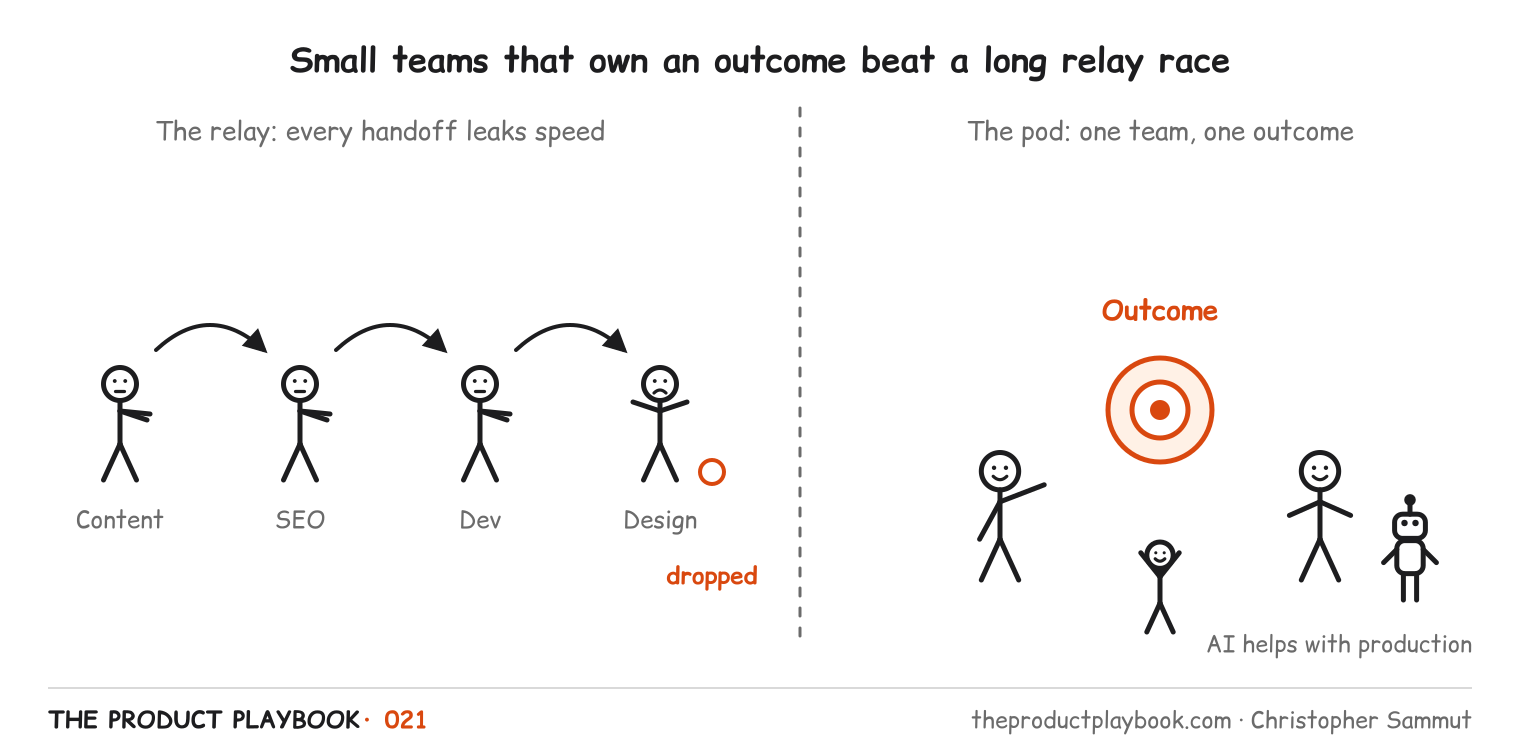
Organise around outcomes, not functions. The old model was a content team, an SEO team, a dev team and a design team, each passing work to the next. Every handoff is a place where speed and context leak out. When AI handles much of the production work, the handoffs become the bottleneck. Small teams that own an outcome end to end beat big functional teams almost every time.
Fewer layers, more builders. A manager whose whole job is coordinating other people’s tickets is the role most exposed to AI. The leaders who thrive still get their hands dirty.
Pay for output, not hours or headcount. When one person with good AI habits can do the work of three, rewarding time spent or team size sends exactly the wrong signal.
Be honest early. If AI is going to change someone’s role, tell them before the rumours do. People cope with change much better than with uncertainty.
Invest in the people who stay. The most valuable people in an AI-shaped company are the ones who learned to use it to do their job better, not the ones who feared it would replace them. Give them the time, tools and permission to experiment.
Borrowed thinking
Two founders I’ve learned from here. Jensen Huang ran Nvidia with dozens of direct reports and no one-on-ones, to strip out layers and keep everyone working from the same information, though critics argue that flat structure made it harder to develop successors. (source)
Deel’s Alex Bouaziz was advised to replace his early leadership team as the company scaled. He kept them, and credits that choice for much of the growth that followed. (source) Both remind me that structure is a choice, not a template.
The question to ask yourself: if I designed this team from scratch today, knowing what AI can do, would it look like the team I have? If not, what’s stopping me from moving towards it?