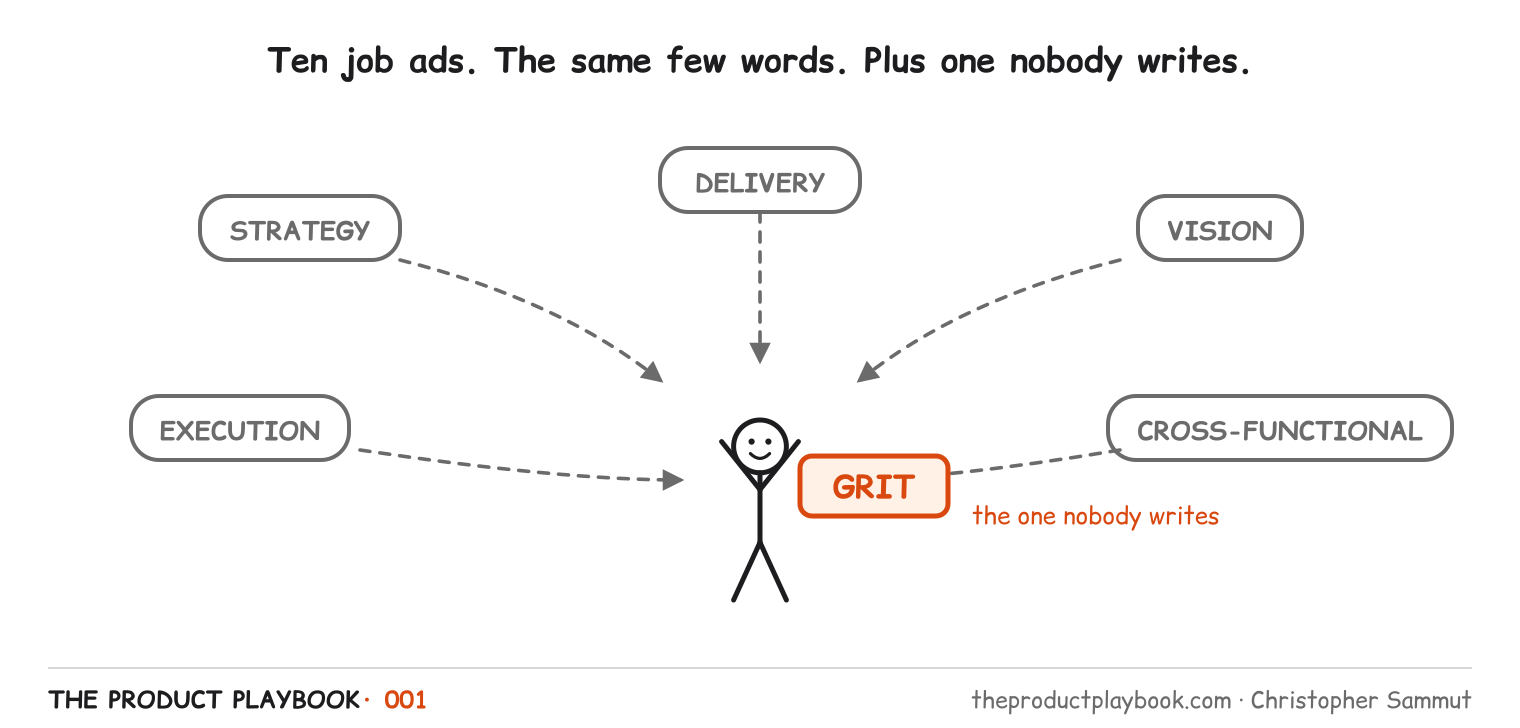
Read ten product manager job descriptions and you’ll find ten different jobs. I noticed that years ago when I was looking for my own next role, and I noticed it again from the other side of the table, hiring product people and, later, leading product leaders myself.
But the same words keep showing up: strategy, vision, execution, cross-functional, delivery. And there’s one I always add that never makes it into the ad: grit. Product is a job where you’ll be wrong in public, often, and still have to get up the next morning and push.
I use the word “owning” carefully. You rarely own the people who build the product. You lead without authority, across engineering, design, marketing, compliance and support. That’s why the soft skills matter more than any certificate:
- A great communicator. Every person has different skills, a different background and a different way of hearing things. Your job is to be understood by all of them (more in 005).
- Empathy. For the users you build for, and for colleagues, who are often users too if you build internal tools (more in 002).
- A team player. No product manager is an island. Your objectives are shared objectives, or they’re just wishes.
- Problem solving and resourcefulness. Analytical enough to understand a problem, creative enough to find a way through it, and decisive enough to avoid analysis paralysis.
Here’s what I’ve learned since writing the first draft of this chapter: the best product people I’ve worked with weren’t defined by their title. They were defined by curiosity and ownership. They asked “why?” more than anyone else in the room, and they treated the result as theirs even when the org chart said otherwise.
Explain it in one sentence
When a family member asks what you do, you’ll find yourself in a mental vacuum looking for an answer. No day is the same. No day can be. Product people used to be seen as the GSD people, the ones who get stuff done. Today they’re closer to the mini-CEO of the product: the glue between design, engineering and the business, and everything in between (marketing, compliance, security, performance, yada-yada).
My one-sentence version: solve the right problem, and solve the problem right.
My first team was a web desk of two people at a forex broker. Two and a half years later it was eight. I learned more about the soft skills above in those years than in any course since, especially one I left out of my first draft: accepting constructive criticism. Negative feedback is just as important as positive. What matters is what you learned from it and what you did next.
The question to ask yourself: if I took my job title away tomorrow, what would people say I’m known for? If you don’t like the answer, start there.